Search This Website

Showing posts with label Nishtha. Show all posts

Thursday, February 3, 2022

Nishtha Answer Keys


NISHTHA

The Department of School Education and Literacy has launched a National Mission to improve learning outcomes at the elementary level through an Integrated Teacher Training Programme called NISHTHA under the Centrally Sponsored Scheme of Samagra Shiksha in 2109-20.


NISHTHA is a capacity building programme for "Improving Quality of School Education through Integrated Teacher Training". It aims to build competencies among all the teachers and school principals at the elementary stage. NISHTHA is the world's largest teachers' training programme of its kind.The basic objective of this massive training programme is to motivate and equip teachers to encourage and foster critical thinking in students. The initiative is first of its kind wherein standardized training modules are developed at national level for all States and UTs.


PRAGNA MODULE  ANSWERS 2022 

PRAMBHIK BHASHA SHIKSHAN


Highlights of NISHTHAHighlights of NISHTHA

Capacity building of 4.2 million teachers

Integrated training of principals/heads as key academic support

Focus on competency and higher order thinking skills based teaching learning


Training of all heads and teachers as first level counselors

Promoting experiential and joyful learning

Awareness of centrally sponsored schemes/initiatives

Online monitoring and support system

Convergence of multi-departmental efforts

Activity based training modules


FEATURES


Course Material

Current Activities

Website Tutorials

Resources

Training Reports

Showcase Practices

Gallery- Videos & Images


Nishtha 3.0 Module Aheval Click Here


Expected OutcomesExpected Outcomes

Improvement in learning outcomes of the students


Nishtha 3.0 Answer Keys


Module 1 Click Here

Module 2 Click Here


Module 3 Click Here

Module 3 Click Here YouTube Link


Module 4 Click Here

Module 4 Click Here YouTube Link


Module 5 Click Here

Module 6 Click Here


Module 7 Click Here

Module 8 Click Here


Module 9 Click Here

Module 10 Click Here


Module 11 Click Here


Module 12 Click Here


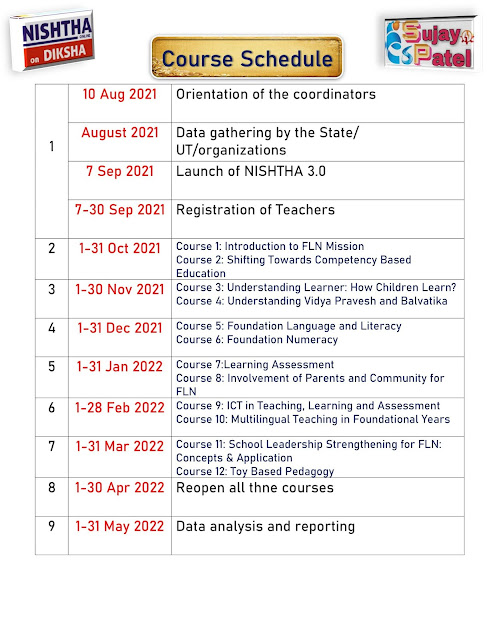
Nishtha 3.0

Our Join Whats App Group Click Here


Creation of an enabling and enriching inclusive classroom environment

Teachers are trained as first level counselors to be alert and responsive to the social, emotional and psychological need of students


Teachers are trained to develop and strengthen personal-social qualities of students for their holistic development

Creation of healthy and safe school environment

Integration of ICT in teaching-learning and assessment

Develop stress-free School Based Assessment focused on development of learning competencies

Teachers adopt Activity Based Learning and move away from rote learning to competency based learning

Teachers and School Heads become aware of new initiatives in school education

Transformation of the heads of schools for providing academic and administrative leadership in the schools for fostering new initiatives


Nishtha 3.0 Module Aheval Click Here


OFFLINE COURSE MODULES - GENERIC


Curriculum, Learner-centered Pedagogy, Learning Outcomes and Inclusive Education

Improving Social-personal Qualities and Creating Safe and Healthy School Environment

Art Integrated Learning

School Based Assessment

Health and Well Being

Integration of ICT in Teacher-Learning and Assessment


RELATED LINKS


Department of School Education and Literacy

NISHTHA

Samagra Shiksha

NISHTHA related Feedback

Contact/Helpline

PIB Release - NISHTHA

Read More »

Monday, November 29, 2021

Nishtha 3.0


Course  Information


Description of the Course

       The Ministry of Education, Government of India has  declare a Foundations Literacy and Numeracy (FLN) Mission and provide   relationship ship to build literacy and numeracy  ability among children at the foundational stage. This course deals with the  ambition and objectives of the mission and highlights the role of unlike stakeholders.


Nishtha 3.0 Join Link Below

(5) GJ 5 'Vidhya Pravesh' Ane 'Balvatika' ne Samajava

(6) GJ 6 Payani Bhasha Ane Saxarata


(7) GJ 7 Prathamik Dhoran ma Bahubhashi Sixan

(8) GJ 8 Shaixanik Mulyankan


(9) GJ 9 Payani Sankhyagyan

(10) GJ 10 Payani Saxarata ane Sankhyagyan mate Shala Netrutv


(11) GJ 11 ICT nu Shikhava, Shikhavava ane Mulyankan Sankalan

(12) GJ 12 Payana Tabakka Mate Ramakada Adharit ShikshanShashtra


 Keywords

FOUNDATIONAL LITERACY, FOUNDATIONA NUMERACY, FOUNDATIONAL EDUCATION, FLN, MISSION, EDUCATION, EARLY CHILDHOOD, CARE, ECCE, NISHTHA FLN


 notice of Competency Based Education

Children come to school from different backgrounds and   climate . Some children have parents and  grow up in the family who engage with them. They play, tell stories,  supply collective language experiences, provide safety,connections and high quality routines, which are  enhancing and interesting for children. On the other hand there are children who have  skillful less fortunate early childhood years, without secure attachments, safety and  relationship , good nutrition and rest, and without enriched learning  chance . As a result, children have differences in readiness for school when they begin preschool or kindergarten.  also , children in the same class might have 12 months age differences. There are differences in the levels of language  ability , visual-motor  ability , diversity in socio-economic


contexts and home  environment .

And when children from diverse backgrounds having different learning needs enter the typical school, all the students are expected to be ready for grade-level content standards to be covered and tested in a time-limited learning system. Most of the time the focus is on completing the syllabus without  observe whether children are learning to a level of deep


NISHTHA 3.0 Answer Keys Click Here


understanding and application. When similar  order are provided and one time testing is used for all the children, without considering their learning levels, children are   fastly categorized as winners and losers. By the end of third grade, children have settled into patterns of learning that  relationship persist for life.


NISHTHA 3.0 AHEVAL FILE CLICK HERE


AHEVAL 1 PDF CLICK HERE

AHEVAL 2 PDF CLICK HERE

AHEVAL 3 PDF CLICK HERE

AHEVAL 3 PDF CLICK HERE YouTube Link

AHEVAL 4 PDF CLICK HERE

AHEVAL 4 PDF CLICK HERE YouTube Link

AHEVAL 5 PDF CLICK HERE


AHEVAL 6 PDF CLICK HERE


AHEVAL 7 PDF CLICK HERE


AHEVAL 8 PDF CLICK HERE


AHEVAL 9 PDF CLICK HERE


AHEVAL 10 PDF CLICK HERE


AHEVAL 11 PDF CLICK HERE


AHEVAL 12 PDF CLICK HERE


What are Learning Outcomes?

 await learning outcomes define the totality of   information , knowledge, understanding, attitudes, values, skills or  action a learner should master upon the successful completion of the curriculum. Learning outcomes are essentially  proof of having acquired the competencies. Learning outcomes are particular statements that  particular exactly what a student will be  cleaver to do in some measurable way. There may be more than one  quantifiable outcome  explain for a given competency. Achieved learning outcomes can only be  recognition following the learning process, through assessments and  proof of  attain learning in real life, for example, at work. The performance of the child in each subject area needs to be  always matched with the intended learning outcomes. Children who are not performing up to the expected level need to be provided scaffolding and support by the teachers and parents. Outcomes-based qualifications provide students, teachers, parents and other stakeholders with a common reference point, which allows aimed and active learning processes and better quality teaching


NISHTHA 3.0 Answer Keys Click Here


Assessment of Learning Outcomes

Formative assessments are emphasized so that teachers get to understand where students are facing difficulties or having misconceptions. Teachers can extend help and give feedback to children about their performance and areas where they need to improve. Assessment is used as a guiding tool, which is meaningful and provides positive learning experiences for children. Students construct their own knowledge by actively participating, applying critical-thinking and problem-solving skills along with good communication skills, collaboration and cultural responsiveness to help them work in ever-changing, diverse environment. Teachers can use anecdotal records, peer  evaluation , self- assessment, rubrics and portfolio to track students’ progress.


Read More »